My name is Emily Bohman, and I am from Yorkshire, Ohio. Yorkshire is located about two hours north of here; it is a very small town not known to many. I live on a country road surrounded by fields, and I attended Versailles High School. I am currently a Junior at Thomas More majoring in Middle Childhood Edcuation. My two content areas are social studies and english.
I come from a family of six. My dad's name is David, and he is a construction worker. My mom's name is Mary, and she is an ER nurse. I also have an older brother Mitchell, who attends Toledo University, a younger brother Ryan, who is a senior in high school, and a younger sister who is a freshman in high school. Lauren, my younger sister, plays volleyball and runs track.
My family is very important to me and we do lots of stuff together. Some of the things that we like to do as a family are: camping, boating, campfires, biking, watching movies, church, and just hanging out in general. We are also into sports, especially football. The college team that we all like is Ohio State; my family likes the Bengals, but I am an outcast and like the Browns! We also love watching basketball and baseball. Most of us kids played some type of sport growing up. I played volleyball, basketball, and softball from junior high through high school. I now play volleyball here at Thomas More.
Monday, January 10, 2011

Saturday, January 8, 2011
The Bee Conundrum aka Did We Screw Everything Up (Again)?
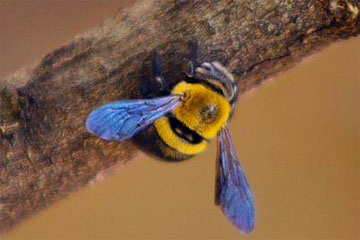
Headway has recently been made in the investigation of colony collapse disorder as experienced by the honeybee. Colony Collapse Disorder (CCD)is a phenomenon in which worker bees from a beehive abruptly disappear (yeah, very specific, right?). While such disappearances have occurred throughout the history of agriculture, there's been a recent widespread escalation in the occurrence. The term "colony collapse disorder" was first applied to a drastic rise in the number of disappearances of Western honey bee colonies in North America in late 2006.[2] Colony collapse is economically significant because many -most- agricultural crops worldwide are pollinated by bees -if you want to take a more anthropocentric point of view.
More recently, an American study involving collaborating scientists from multiple U.S. universities studied eight bumble bee species from across the country for three years, paying special attention to changes in their distributions, genetic diversity, and infection rates. Their report, published in the Proceedings of the National Academy of Sciences, is the first to comprehensively survey bumble bee populations in the U.S. The team compiled a database of more than 73,000 museum records and compared them to current population assessments determined through intensive surveys of more than 16,000 specimens at 400 sites. The study was the first national large-scale survey of bumble bee population health and found that four of the eight species studied had declined by as much as 96 percent, and that their ranges had shrunk by 23-87 percent. There are 50 species of bumble bees in North America, the team studied 8 and 4 of those are in serious trouble.
Kind of a big deal.
While a cause has yet to be confirmed, the presence of the bumble bee pathogen Nosema bombi in the diminished populations supports previous hypotheses that the escape of N. bombi from captive pollination colonies is responsible for decimating wild populations. However, the paper cautions that more research is needed in order to determine whether the pathogen is capable of affecting a healthy population or simply taking advantage of ones already weakened by something else. Oh, and you know where N. bombi came from? Commercial hives. And so do you know who's responsible for exacerbating the problem? Give you one guess...
Monday, December 20, 2010
A Forgotten Constant
I think it's a shame that the humanities leaves out human interaction and relationship with nature. We become who we are and develop as we do as a consequence of our natural environment. Human development and progress are inextricably linked, I think. But maybe that's the problem. Maybe our dependencies, reliance and interactions with nature are so permeable, so overarching, that they are forgotten -rather, not taken as a given, but regarded as a constant to be ignored... which may not be so constant.
And now, a lamentation of sorts in the words of Thoreau:
And now, a lamentation of sorts in the words of Thoreau:
Here is this vast, savage, howling mother of ours,
Nature, lying all around, with such beauty, and such affection for her children,
as the leopard; and yet we are so early weaned
from her breast to society, to that culture which is exclusively
an interaction of man to man.
Friday, November 12, 2010
Outdated Aruguments

In October of 1998, the International Food Information Council published an article addressing food biotechnology and the environment. Their claim was that food production for the world's growing population takes its toll on the environment -an indisputable fact. Erosion of rich topsoil, pollution from farm chemicals, depletion of water supplies, adulteration of graze lands and deforestation all plague the natural world. They argue that these unfortunate aspects of modern agriculture could be completely eliminated, that the environment can be spared via... biotechnology (yeah, I thought they were going to say organic farming methods too).
So, the article goes on to list various reasons why biotechnology is a godsend for the environment. Some of these arguments are legitimate while others seem a little short-sighted. And then I came to section where they list how biotechnology and its use in agriculture and plant breeding has already been a huge success -and I couldn't help but laugh out loud. From the vantage point of 1998, American tree breeders had triumphed, producing, with the aid of genetic engineering, a Dutch elm tree immune to Dutch elm disease and an American Chestnut tree protected from chestnut blight! They tell how Brazilian eucalyptus plantations enjoyed a 112% yield increase since employing modern cloning techniques! And at this point I'm on the floor laughing 'till I cry (not literally, but I could have been).
So, yeah, two new breeds of Dutch elm were produced via cloning techniques, which was a major breakthrough, but has since not helped the forests of native American elm trees. The disease was brought to the US via exotic beetles carrying an exotic fungus that wreaked havoc on trees in Europe. It was introduced to elm plantations in America, where vast monocultures of elms were grown for lumber and were produced by means of root grafting, so that sap might be exchanged underground from one tree to another. In short, a disease was introduced into an artifical, homogeneous elm forest, in which every tree was attached to the other. Of course, it spread like wildfire, and of course the creation of a disease-resistant variety is a panacea for owners of tree plantations... but this did nothing for American elm trees in forests, and Dutch elm disease continues to be a threat today.
The creation of an American chestnut tree resistant to chestnut blight has a similar story. I don't deny that the existence of a resistant tree might still prove to be beneficial or even crucial to the tree's survival. Since 1998, however, the American Chestnut has been listed as an extinct species for all intents and purposes. Individuals still exist, but these trees will never make it to the stage of viable reproduction. The species is as good as dead today -despite the miracle of bioengineering 12 years ago.
The story about the eucalyptus plantation is true enough. Plantations in Brazil have flourished with the introduction of this high-yielding variety of tree... and the local environment is suffering for it. This past September, The Global Justice Ecology Project compared the eucalyptus in Brazil to the kudzu problem in the southern states of the US. They claimed that a South Carolina-based company had the "muddle-headed idea" to plant 330 acres of Australian eucalyptus genetically modified to withstand cold weather. They said that "[t]he idea is that the tree, native to Australia, could be used commercially to make paper and as fuel for power plants. The Summerville, S.C.-based ArborGen, says the hybrid it would use can't easily reproduce. People thought kudzu was a good idea, too."
The trees, aside from taking over space and crowding out native species, have robbed native wildlife of food and shelter resources, threatening Brazilian ecosystems. In addition, even when the eucalyptus is controlled, this genetically-engineered "supervariety" requires water like you wouldn't believe! True, output will increase, but substantial amounts of water are needed to support this output. Currently, one of the wettest places on earth -the Brazilian rainforest- is running out of water... But back in 1998, this marvel of biotechnology had saved the world!
Not all of the article's points were so very flawed. The benefits to the pharmaceutical indistry that the authors point out have proven to be very useful in today's medical world. Other arguments about the need to replace chemicals and fertilizers with GM plants and the impossibility of supporting a growing population without increasing yield per acre via bioengineering are still debatable and highly contested today. But these examples I've presented here, as well as others that I didn't mention, just go to show that, in some instances, only time will tell.
Thursday, October 7, 2010
Livestock to Raise Greenhouse Emissions

Experts are speculating -as they are wont to do- that soaring international livestock production could single-handedly release enough carbon into the atmosphere to exceed recognized "safe" levels by 2050. A recent study combined figures for livestock production in 2000 with projections for population growth and meat consumption by 2050. The study found that the livestock sector's emissions alone could send temperatures above a 2 degrees Celsius rise -the rise in temperature recognized as the threshold for destabilization (the more conservative estimate is that the livestock sector contributes only 70% of this 2 degree rise). The projections even took into account increased efficiency of grain production.
Canadian researchers have called on governments to prioritize and reign in the livestock sector with new policy. For instance, they suggest a shift away from raising ruminant animals, such as cattle and sheep, to poultry and well-managed fisheries and aquaculture ("well-managed" being the operative adjective). And -because we all saw it coming- they suggest an across the board reduction in per capita consumption of meat and animal products, something they say "may be particularly feasible and advantageous in developed countries."
Friday, October 1, 2010
Sea Slug DIscovery
A new species of sea slug has been discovered by Jeff Goddard, a marine scientist working on a project with UC Berkley. Its name is Flabellina goddardi and it measures only about 30 mm long when stretched out and crawling. You can read about this new discovery at http://www.enn.com/wildlife/article/41826.
Yay for nudibranchs!
Wednesday, September 29, 2010
Wither the Wheat

Uncontrolled fires and the worst drought ina century have sent Russia's farmers scrambling to bring in the wheat crop this year. At the end of August, Prime Minister, Vladimir Putin, announced a temporary ban on grain exports from the country in an effort to increase food security within the nation's borders and to keep prices stable. Despite these efforts, Russian citizens are already seeing the effects of the bad harvest, with their beloved kasha -or buckwheat- disappearing from grocery store shelves. This has sparked a wave of panic-purchases, hoarding and speculation by the Russian people who, form past experience, have witnessed government trouble following the scarcity of staple commodities (flour, sausage, table salt and vodka to name a few).
But the trouble isn't contained within the nation's borders. With the absence of Russian wheat in the global marketplace and the increased demand of grain imports into Russia, the price of wheat has been steadily rising -and with the increasingly dismal projections for Russia's wheat crop (even now only 30% of the allocated cropland has received enough rainfall for a winter wheat planting) the situation looks to only be getting worse for consumers. In wealthy nations, where food dollars account for only a fraction of the family income (7% in the USA), this rise in grain prices is a nuisance, but in less wealthy nation, food dollars can account for as much as 80% of total income, making a rise in the market price a very big deal. Riots in Mozambique have already erupted earlier this month in response to a 25% increase in the price of bread.
At the same time, there are those who secretly enjoy Russian farmers' misfortune -namely, other wheat farmers around the world. With the price of wheat being driven up and the increased demand in not only Russia and Eastern Europe, but all over the world, Framers in the United States and Australia have much to gain. Already, Egypt, the world's largest importer of wheat, has committed to purchasing 225,000 metric tons of wheat from the US for a price 5% higher than a month ago. The UN has raised export estimates for the US to43% after Russia's wheat forecast dropped 10% at the beginning of this month. US corn is becoming more profitable as livestock producers switch from other grains to corn-feeding their animals and despite a dry season and expected locusts later in October, Australian farmers have made a strong start and expect to profit from increased exports as well.
Subscribe to:
Posts (Atom)